Köbberling & Kaltwasser: The Games Are Open
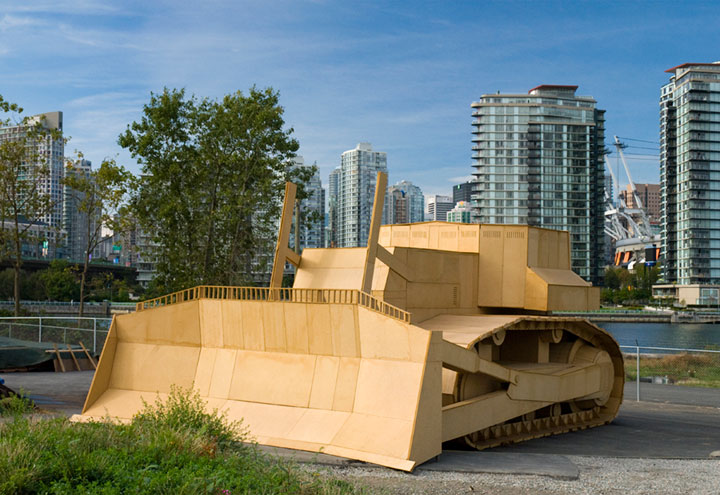
NORTHWEST CORNER OF THE OLYMPIC VILLAGE, VANCOUVER, BC
September 2010 – 2015
Curated by Barbara Cole
SEE K&K Release, Sep 10 ’10
SEE Commissioned Text by Holly Ward: “The Transcendental Monument on Kobberling & Kaltwasser”
Learn more about the publication.
The Games are Open took the form of a larger-than-life bulldozer – with shovel down, it faced the expanse of interim lands awaiting future development along Vancouver’s South East False Creek. Artist team Folke Köbberling and Martin Kaltwasser began the sculpture’s construction three months after the 2010 Winter Olympic competitors vacated the neighbouring Athletes Village. Marketed as Canada’s “greenest” housing development, the Village was transitioning from sporting dormitory to home. Piles of carpeting and stacks of paneling accumulated outside the empty buildings as evidence of the measures taken to protect the investments of condominium owners from the vagaries of the temporary lodgers. Kitchens, considered to be the most valuable of rooms with their stainless steel appliances, quartz countertops and Grohe faucets, were sheathed in wheat board, a new “environmentally friendly” material composed of 94% wheat and 6% neutral binder.
Installed in January, removed in March, and liberated by Other Sights in June, 1,000 of these panels were used as the primary material in Köbberling and Kaltwasser’s ambitious, 9-week construction. Typically employed as a substrate for interior finishings, the wheat board took on a structural role in the depiction of a machine usually associated with fast and drastic change. Having researched the affects of soil microbes, inclement weather and the passing of time on the wheat board, the artists embraced its vulnerability by adding soil to some of the structure’s cavities in anticipation of eventual spills and collapse. Implicit to the artists’ intent was the conjecture the decomposing artwork would become compost, with the potentiality of providing fodder for new growth. Without predetermining the project’s outcome, they hoped it would be taken over by seedlings germinated either by the wind or planted by local gardeners – perhaps the bounty would be offered for transplanting throughout the future westward creeping development.
The artwork occupied City-owned land and the artists understood The Games are Open’s future would inevitably be determined by capital and municipal neoliberal strategies. At times, the project was co-opted by urban planners as an example of sustainability – the wheat board bulldozer’s generative action was seen to further the Mayor’s goal to become the greenest city in the world by 2020. When graffiti appeared, the Graffiti Management Program quickly assumed the role of a conscientious steward and removed it. Some local residents declared the sculpture to be in their backyard and could be overheard explaining to visitors how the work’s organic chaos offered relief from the groomed and overly planned and designed environment of the Village. Others chose to complain to the City’s hotline about this derelict eyesore that threatened to reduce the value of their property by virtue of its very existence. The piece was included on public art walking tours and urban planning symposia, and gradually occupied a place within the City’s public art collection as a temporary work of undetermined duration.
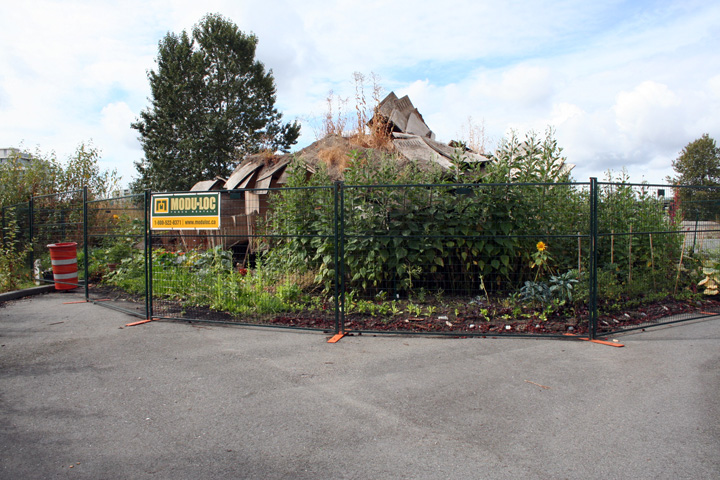
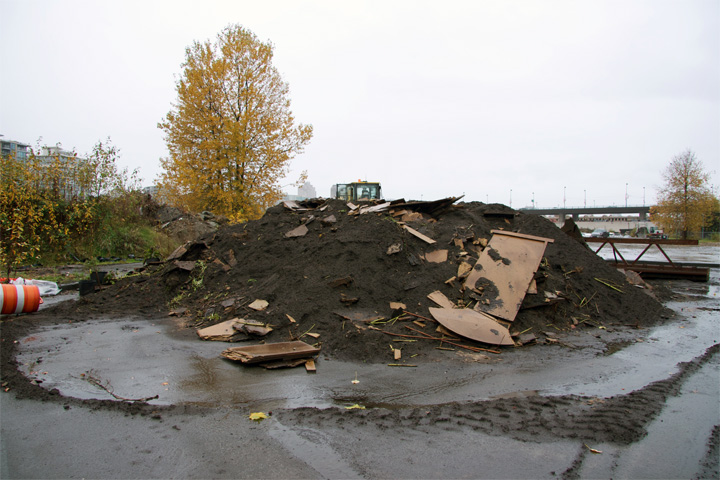
In the Spring of 2013, the City approached Other Sights with an offer to bring resources to further the artwork’s greening. Cautious, but open, the offer was accepted and a thick layer of rich compost was added to all surfaces that fell within the front-end loader’s reach. The quality of the soil and exposure to southern light did not go unnoticed by a local gardener and within one week, the soil around the sculpture’s perimeter was raked and seeds were planted for what became a lush and varied vegetable garden. Artichokes, radishes, carrots, zucchini, heirloom tomatoes, kale, scarlet runner beans, sunflowers, lettuce and endive, were tended with care and expertise. The audience for the decomposing artwork expanded beyond the visual arts community and those interested in urban planning and sustainability issues, to include urban farming and gardening enthusiasts. Following the public’s gaze, the City responded by erecting a second fence around the artwork/garden. Voicing concern about falling parts and exposed screws, they effectively corralled the efforts of the rogue gardener. By October, the City offered another load of soil with the proposal to fill some of the voids in the structure maintaining there were signs of ‘nesting’ and drug activity. With soil and backhoe arriving one day in advance of the agreed upon date, the sculpture and garden were buried in a heavy-handed action that abruptly shifted the project’s narrative.
Over the three years of the project’s existence, the artwork’s form shifted from sculpture, to garden, to dirt pile, each transformation driven by the agendas of assumed owners. Presented within the context of land speculation that is embedded within Vancouver’s history of building up and tearing down, the sculpture’s iconic representation of a macho-machine devolved from within – as the structure weakened, the artwork’s social value increased. The Games are Open was subject to economic, biological and social forces. Its vulnerability invited re-invention, not through the grand gesture of building a monument, but through the modest act of planting a seed.
-Barbara Cole, November 2013
UPDATES
October 17, 2015
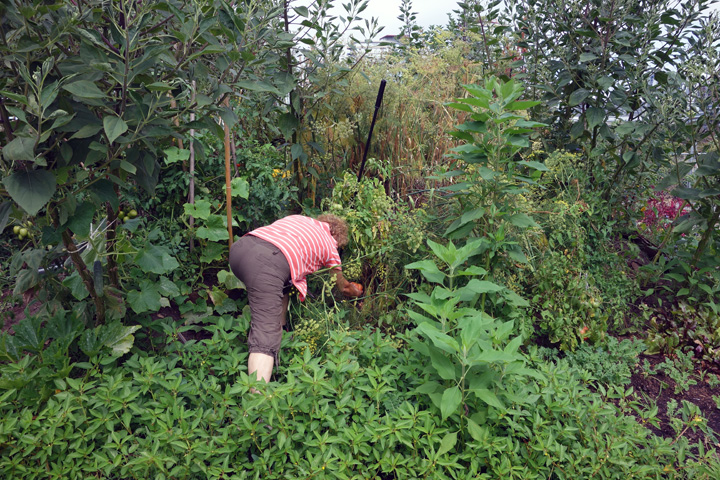
At the site of The Games are Open on a mound of soil and bits of wheatboard, Eklas Miller continues to fight for the right to nuture her garden.
Nadia Stewart, “Woman turns Olympic Village eyesore into a garden; City of Vancouver says it has to go”. Global News. October 16, 2015.

June 13, 2015
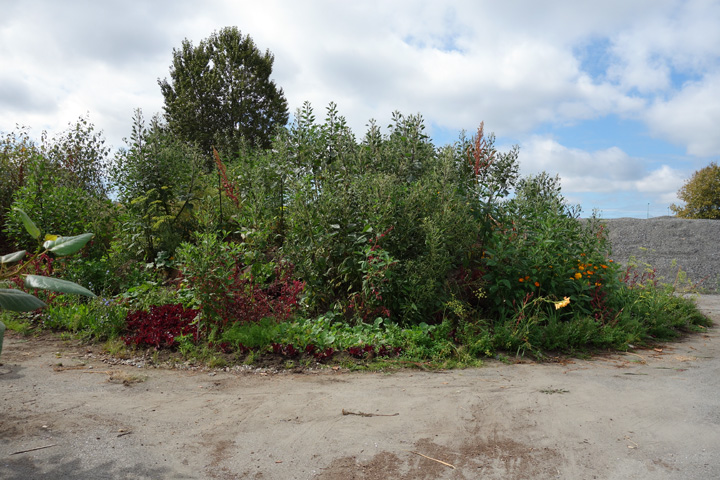
For three summers now, Eklas has been gardening the mound that was The Games are Open by Folke Kobberling and Martin Kaltwasser. The garden was threatened earlier this summer, but through the help of many passersby expressing their support to the City, she was granted another growing season. With all this fabulous weather, the garden is abundant with tomatoes, cucumbers, zucchini and kale. Give Eklas a thumbs-up as you walk by!
Bob Kronbauer, “Good news for the Olympic Village community garden!”. Vancouver is Awesome. June 12, 2015.
Amy Judd, “Vancouver woman fights to keep community garden”. Global News. June 9, 2015.
September 1, 2014
Two different videos about the project have recently come to our attention. Thanks to both Heroes2 and Hans Sipma for their interest in, and enthusiasm for The Games are Open!
“Urban Heroes. Adam and the Art-Fore Garden – urban organic gardening heroes”. YouTube video. Posted by “Heroes2 Environmental NGO”, August 26, 2013.
Young Adam Yap interviews Eklas Miller, a local resident who took up the challenge of greening the wheat board bulldozer to create an inventive and productive vegetable garden.
“An Olympic Deconstruction”. YouTube video. Posted by Hans Sipma, June 9, 2014.
Vancouver-based photographer Hans Sipma passed by the decomposing wheat board bulldozer everyday on his bicycle commute to work. He photographed the sculpture over a four-year period and created this time-lapse video.
A big heartfelt thanks to Eklas Miller who has continued to bring beauty and life to the sculpture’s ongoing decomposition. These 2 pics were taken on August 28, 2014.
INFORMATION ABOUT THE PROJECT (posted in 2010)
As South East False Creek began its new life as Canada’s largest ‘green’ housing development, the Berlin-based artist team of Folke Köbberling and Martin Kaltwasser used materials recycled from the 2010 Olympic and Paralympic Winter Games Athletes’ Village to create a situation of exchange and cooperation. On lands slated for future development, the artists created a 6 x 7 x 14m artwork that invited the participation of new neighbours to liberate the discarded, share excess, and contribute to the building of new forms and meanings.
About the Artists Köbberling & Kaltwasser create situations that encourage the participation of diverse publics. Their work uses informal methods to make visible the transformation of begged, borrowed, donated, salvaged, and found materials into publicly used objects and spaces. They have exhibited extensively in Germany and internationally and were included in the 2009 Architecture Biennial in Sao Paulo and in the 2010 Poznan Biennial. Recent solo exhibitions include Power Plant / Chinati Foundation, Marfa; Galerie Anselm Dreher, Berlin; Ujadowski Castle CSW, Warsaw/PL; Architekturgalerie am Weißenhof, Stuttgart; Artforum Berlin; Lothringer 13/Laden, Munich; Simultanhalle, Cologne; and Shedhalle, Zurich. Recent works for public space include The Jellyfish Theatre in London’s city centre, Cars into Bicycles at Bergamot Station in Santa Monica, California and Trash Circulated, at the Werkleitz Festival.
Curator
Barbara Cole
Project Intern
Karen Garrett de Luna
Project Leaders, Work Crew
Emma Artis, Miguel Da Conceicao, Gabe Daly, Jinhan Ko, Chelsea Trousdell, Desmond Wong
Volunteers, Work Crew
Neudis Abreu, John Armitage, Emma Artis, Matthew Ballantyne, Stewart Burgess, Neil Chung, Gabe Daly, Louis Douesnard, Sherry Gilbank, James Kemp, Christian Kliegel, Chad Manley, Dave Mason, Emilio Rojas, Michael Schwartz, Mike Taylor, Sandy Wang, Steve Williams, Antoni Wojtyra, Desmond Wong, Michael Zife
Emily Carr University of Art + Design Co-op Students, Work Crew
Lance Cardinal, Tony Charlie, Tom Hsu, Sanghyun Samuel Kim, Bahador Saray Sorour, Sarah Storteboom, Chelsea Trousdell, Shuai Zhao
Headquarters Artist
Holly Schmidt
Commissioned Text (website)
Holly Ward – Read Essay
Photo Documentation
Tom Hsu
(Ongoing) Barbara Cole
Funders
British Columbia Arts Council, City of Vancouver, The Canada Council for the Arts, Vancouver Foundation
Partners
Langara College Centre for Art in Public Spaces
Partners in Education
Emily Carr University of Art + Design
Donors and Other Kind Souls
City of Vancouver, Eric Deis Studio, Exchange-A-Blade, Home Depot, Millennium Development Group, PWL Partnership Landscape Architects Inc, Roberts & Stahl Barristers and Solicitors, Second City Printing, The Model Shop, Bob, Germaine and Ian, James and Daniel, Katharine, Landon and Sheila Mackenzie
Above and Beyond
City and Park Board Staff: Bob Chang, Charlie Cuzzetto, Tilo Driesen, Wally Konowalchuk , Manabu Koshimura, Allen Lee, Scott Hein, Bryan Newson, Alix Sales, Joe Snadel, jil p. weaving Langara College: Centre for Art in Public Spaces Steering Committee, Katie Eliot, Eric Stewart and Sylvia Tan
False Creek [T & T]f=”/t-t-false-creek”>False Creek [T & T]